
Mobile-first indexing represents a fundamental shift in search engine architecture, whereby Google predominantly utilises the mobile version of website content for crawling, indexing, and ranking purposes. According to DataReportal (2024), mobile devices now account for nearly 59.6% of global web traffic, with Thailand demonstrating particularly high mobile penetration rates. Furthermore, Google Search Central (2023) confirms that Google completed its transition to mobile-first indexing for all websites in May 2023. This article examines the technical foundations of mobile-first indexing, specific implementation requirements for Thai businesses, and the commercial ramifications of non-compliance.
What Is Mobile-First Indexing?
Mobile-first indexing constitutes Google’s systematic approach to evaluating web content through the lens of mobile user experience. Rather than treating desktop versions as the canonical reference, Google’s algorithms now prioritise the mobile rendering of pages when determining search rankings. This paradigm shift reflects the behavioural reality that the majority of users now access the internet via smartphones and tablets.
The Evolution Timeline
Google’s transition to mobile-first indexing occurred in distinct phases. In July 2019, mobile-first indexing became the default for all new websites. By May 2023, Google had completed the migration of all existing websites to this indexing methodology. While Googlebot Smartphone is now the primary crawler used for indexing and ranking, Google continues to use the desktop Googlebot for auxiliary purposes such as diagnostics, legacy systems, and Search Console testing.
Technical Implementation Requirements
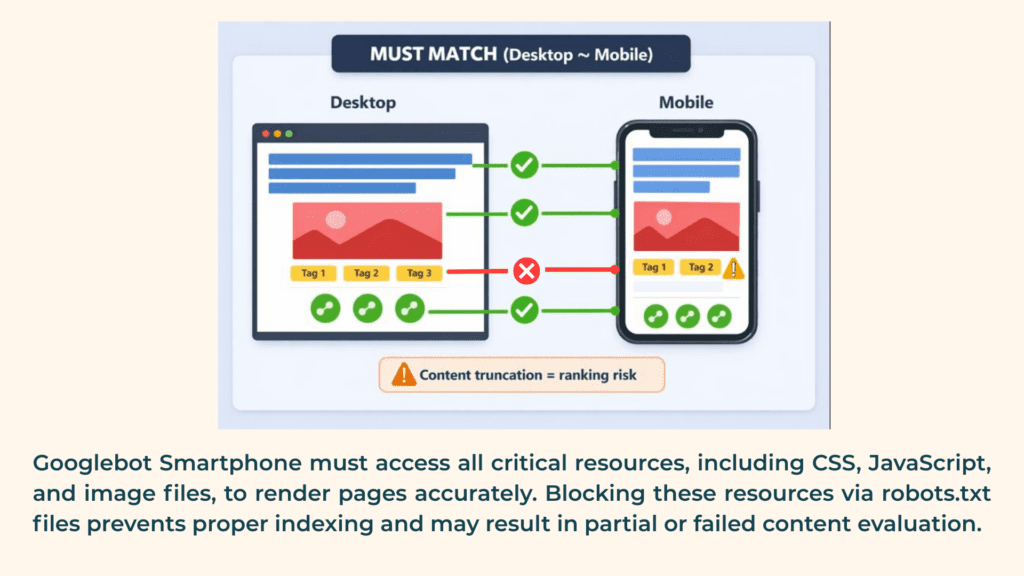
- Mobile and desktop content must be identical
- Match text, images, structured data, and metadata
- No content truncation on mobile
- Maintain mobile-friendly UX and SEO compliance
- Googlebot Smartphone must crawl all resources
- Allow CSS, JavaScript, and image files
- Avoid robots.txt resource blocking
- Blocked assets risk incomplete rendering and indexing
These requirements align closely with broader mobile-friendly web design and SEO best practices, which are essential for maintaining visibility in mobile-dominant search environments.
Business Benefits for Thai Markets
For Thai businesses, mobile optimisation is not merely advantageous but commercially imperative. Thailand demonstrates exceptionally high mobile penetration rates, with the majority of digital consumers relying exclusively on smartphones for online transactions. Organisations that achieve technical compliance with mobile-first requirements typically experience improved search visibility, enhanced user engagement metrics, and superior conversion rates compared to non-compliant competitors.
Common Implementation Pitfalls
Despite the clear benefits, numerous organisations inadvertently compromise their mobile SEO performance through technical errors. Primary among these is the failure to maintain content parity, where mobile sites display abbreviated product descriptions or collapsed FAQ sections. Such discrepancies signal to Google that the mobile experience is substandard, resulting in ranking degradation.
Other critical errors include implementing conflicting metadata between mobile and desktop versions, or utilising JavaScript-dependent navigation without server-side rendering fallbacks. These issues effectively render content invisible to Google’s crawlers, resulting in complete exclusion from search results.
Conclusion
For online retailers, mobile-first indexing intersects directly with conversion performance. Our specialized E-commerce SEO Solutions include mobile-specific technical implementation: optimizing mobile checkout flows, fixing product schema markup for mobile SERPs, and ensuring category pages render critical content without JavaScript dependencies that mobile crawlers may miss.